

Featured Paths / Works
A Manuscript for Lorenzo de’ Medici in the Corsiniana Collection
Cristoforo Landino, De Vera Nobilitate, Firenze, post 1487 (36 E 5)
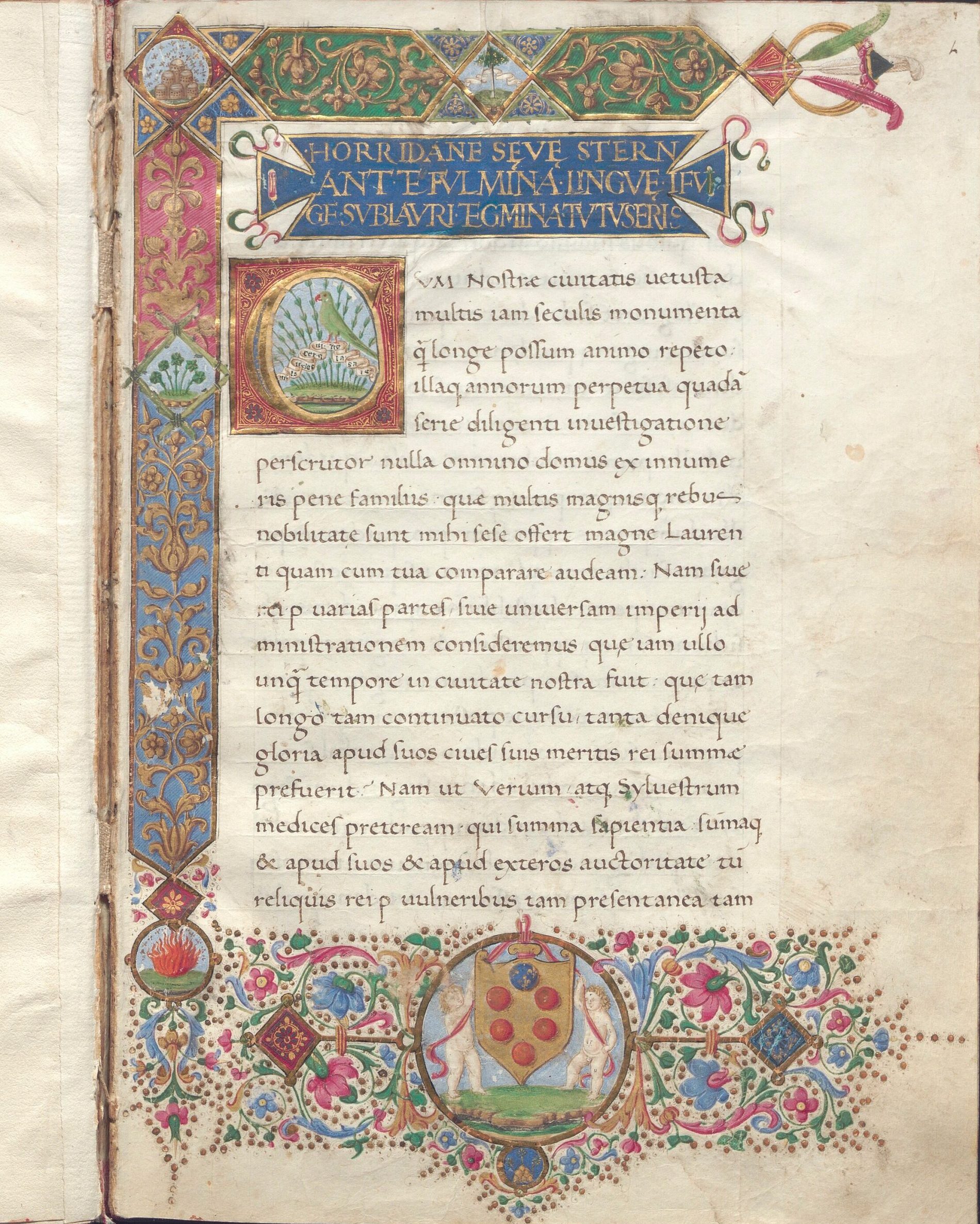
Opening page
Among the Corsiniana’s manuscript holdings is a parchment codex produced in Florence after 1487, closely connected to the circle of Lorenzo il Magnifico. It contains a work by Cristoforo Landino, the refined Tuscan intellectual who lived and worked at the Medici court: De Vera Nobilitate, a philosophical treatise presented as a dialogue between two imagined Greek characters conversing in the house of the Magnifico – a highly important and symbolic location for Florentine culture of the period. The exquisitely illuminated opening page is attributed by most scholars to the collaboration of the miniaturists Boccardino the Elder and Attavante degli Attavanti.

Script Detail
The manuscript features a beautiful lettera antiqua script, probably by a single hand. Scholars have suggested the scribe may have been Antonio Torrigiani, a little-knownTuscan copyist who also produced MS Lat. 126 at Harvard College. Marginal notes, however, were added by a different, unidentified hand.

Lower Border Detail with Medici Arms
The lower border is decorated with blue and red foliate motifs, green leaves, and two small lozenges with rosettes. At the centre, a roundel contains two putti supporting the well-known Medici arms: six red bezants on a gold field, and one blue, bearing the French arms with three fleurs-de-lis, as granted in 1465 by King Louis XI in the Montluçon decree. Below, a very small emblem can be discerned: the personal 8 device of the author, Cristoforo Landino, consisting of a three-peaked mountain surmounted by laurel branches.
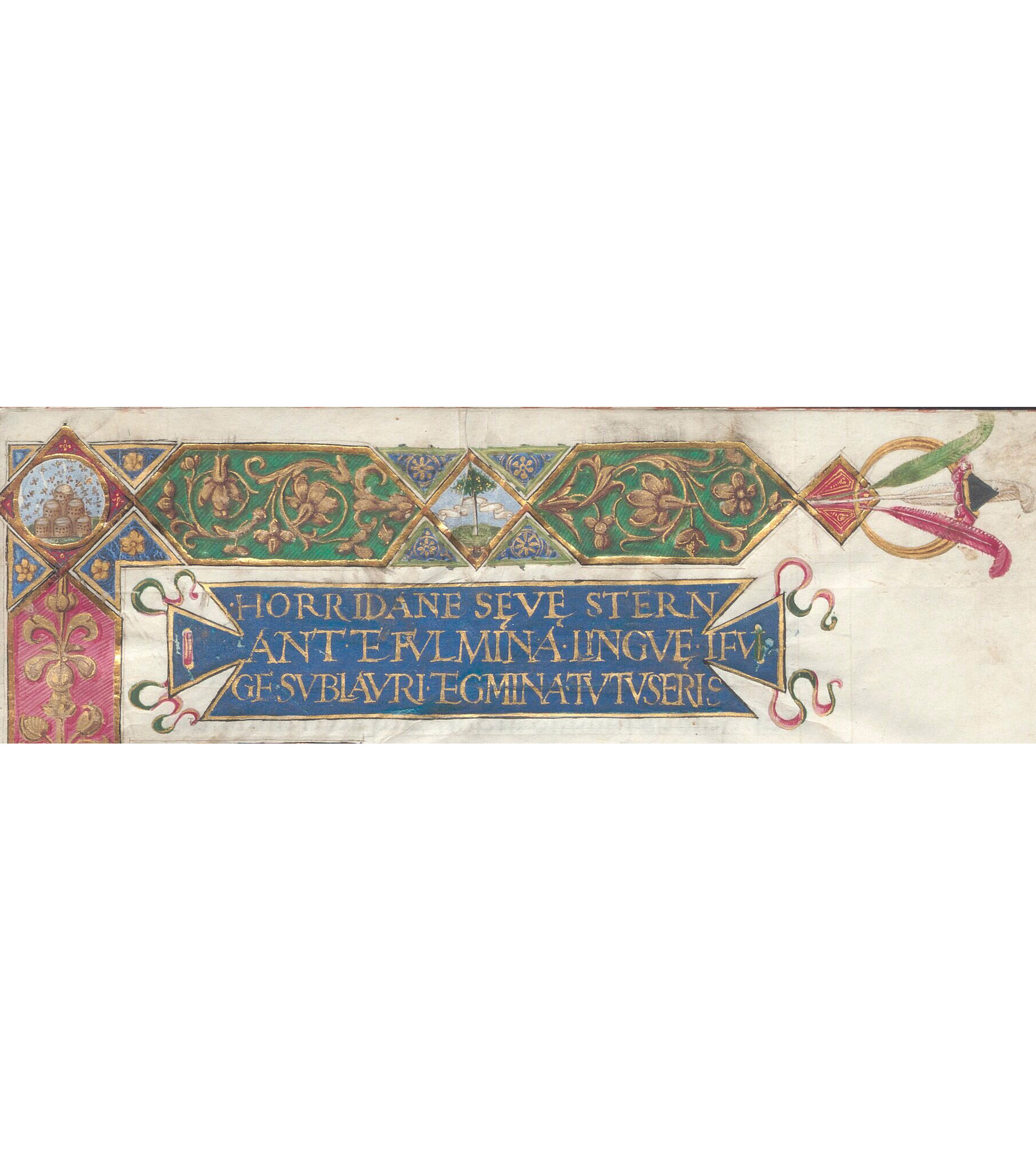
Upper Border Detail
The gilded band delimiting a golden foliate motif on a green background encloses two lozenge-shaped spaces framing symbols of the Medici house: a small laurel tree at the centre and a beehive to the left. The laurel tree, the quintessential symbol of poetry and glory, clearly alludes to the Latin name of the Magnifico (Laurentius), while the beehive is more generally a metaphor for political action. The band ends on the right with a red lozenge featuring a ring topped with a diamond point and three feathers, Lorenzo’s personal emblem.
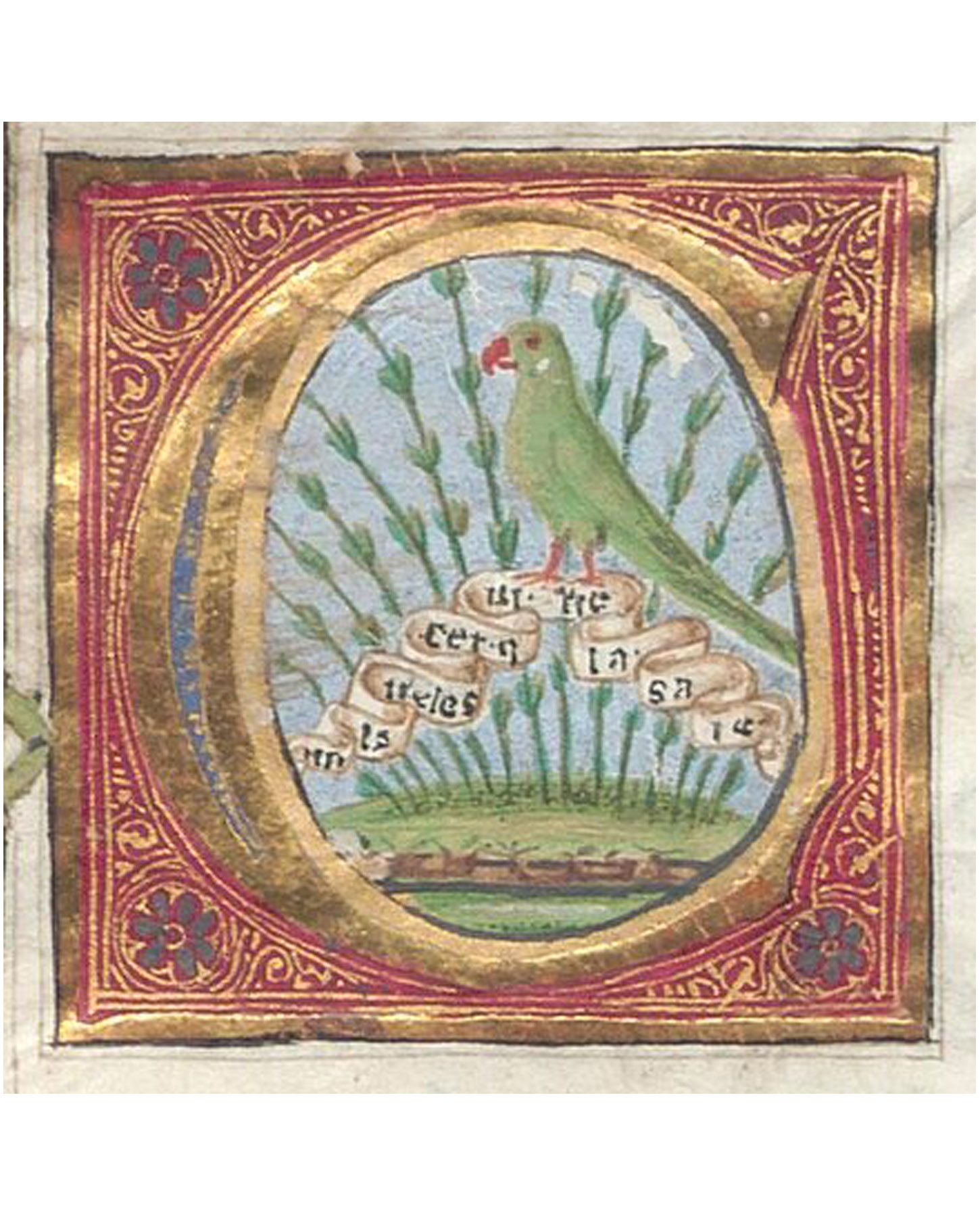
Illuminated Initial Detail
The initial “C” is set against a red background and displays one of the symbols most closely associated with Lorenzo il Magnifico: a green parrot among stalks of millet, accompanied by the banner bearing the motto Non le set qui non l’essaye, asserting the supremacy of experience. The parrot is a symbol of eloquence and may have been chosen specifically in reference to Lorenzo for this reason. This emblem and motto appear in many codices commissioned directly by Lorenzo or dedicated to him, all linked to the project of a rich family library, now largely preserved in the Mediceo Laurenziana